
Environmental protection without borders
Environmental protection without borders
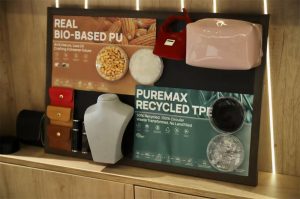
What happens to the 2 billion cups of coffee consumed every day? The spent grounds — roughly 6 million tonnes annually — typically end up in landfills, releasing methane 25 times more potent than CO₂. But in YYF’s Dongguan laboratory, those discarded coffee grounds undergo a remarkable transformation: extracted, restructured, and compounded into sheets of bio-based leather that eventually reach the production lines of Prada, Christian Dior, and Balenciaga.
This is not a lab-scale experiment or a marketing narrative. It is an industrial reality, backed by USDA certification at up to 84% biobased content and validated by some of the most demanding supply chains in the world.
At a Glance:
Up to 84% USDA-certified biobased content | Feedstocks: Corncobs, Coffee Grounds, Bamboo Fiber, Coconut Shell | PFAS-free · DMF-free · Formaldehyde-free · Plasticizer-free | 300+ new eco-materials annually | Trusted by Prada, Dior, Balenciaga, Mont Blanc, Ferragamo, Lacoste & more
Conventional PU (polyurethane) synthetic leather relies almost entirely on petroleum-derived feedstocks. Every square meter of standard PU leather represents a direct draw on finite fossil resources — and carries the embedded carbon of extraction, refining, and polymerization.
Bio-based PU leather changes the equation at its foundation. Instead of using 100% petrochemical polyols, it substitutes a significant portion with plant-derived biopolyols — extracted from agricultural by-products like corncobs, coffee grounds, coconut shells, and bamboo fiber. These natural molecular building blocks are chemically integrated into the polyurethane backbone, not merely blended in as fillers.
The result? A material where up to 84% of its carbon originates from plants rather than petroleum — verified by the USDA BioPreferred Program. From a lifecycle assessment perspective, this is a step-change in material decarbonization.
YYF’s feedstock selection is deliberate. Coffee grounds are the world’s most voluminous beverage by-product — abundant, cheap, and currently landfilled at scale. Bamboo, on the other hand, is among the fastest-growing renewable resources on the planet, reaching harvest in 3-5 years versus 20-50 for hardwoods. Both are sourced through FSC-certified channels where applicable, and crucially, neither competes with food crops for land or water. These are true waste streams and high-efficiency renewables — not dedicated industrial crops that drive deforestation or food price inflation. In ESG scoring, this distinction carries significant weight.
Turning coffee grounds into premium leather is not a matter of simple physical mixing. YYF’s 19 years of material science expertise (founded 2006) have yielded a fully industrialized production system:
The entire process takes place in YYF’s dual-location smart factories in Dongguan and Shenzhen, which operate at 95% energy recycling efficiency and zero wastewater discharge, with an ISO-certified in-house testing laboratory that validates every batch against rigorous physical and chemical compliance standards.
Within YYF’s bio-based product matrix, the 100% bamboo fiber bio-based leather stands out as the most differentiated line. Unlike some market offerings that add only trace amounts of plant powder to conventional PU as a marketing exercise, YYF’s bamboo fiber leather uses bamboo-derived cellulose as a primary structural component:
| Performance Attribute | YYF Bamboo Fiber Bio-Based | Conventional PU | Genuine Leather |
|---|---|---|---|
| Biobased Content | Up to 84% (USDA-certified) | 0% | N/A |
| Carbon Footprint | 40-70% lower vs. baseline | Baseline | Highest (livestock emissions) |
| Abrasion Resistance | Excellent — meets luxury brand standards | Good | Good-Excellent |
| Hazardous Substances | PFAS-free, DMF-free, formaldehyde-free | May contain DMF residuals | May contain chromium (tanning) |
| Hand-Feel | Silky-soft, skin-friendly | Plastic-like | Naturally warm |
| Consistency | High (industrial production) | High | Low (natural imperfections) |
| Weight | Lightweight | Medium | Heavy |
Bamboo fiber inherently brings anti-microbial, moisture-wicking, and breathable properties. The resulting leather has a hand-feel closer to premium textile than to cold plastic film — precisely the kind of “material language with warmth” that luxury designers seek for next-generation accessories.
In the environmental materials space, the credibility of any green claim hinges on the depth of third-party verification. YYF has built a compliance framework covering every major global market:
Triple-Zero Pledge: Every meter of YYF bio-based leather is guaranteed PFAS-free, DMF-free, formaldehyde-free, and plasticizer-free — eliminating the chemical residue concerns that have historically plagued synthetic leather adoption in high-end applications.
Perfume boxes, jewelry cases, watch boxes, premium spirits packaging — these applications demand absolute consistency in texture, color, and scent. YYF’s bio-based leather was showcased at LUXE PACK Paris 2026 and received collaboration inquiries from dozens of global luxury groups.
The supply chains of Prada, Christian Dior, Balenciaga, and Salvatore Ferragamo have integrated YYF’s bio-based materials. These brands are under increasing pressure to decarbonize their Scope 3 emissions, and bio-based leather offers one of the most material-ready pathways.
Lacoste and Ray-Ban’s footwear lines are adopting YYF’s bio-based materials. The lightweight and breathable properties of bamboo fiber leather perform particularly well in athleisure and casual shoe categories.
Samsonite, Delsey, and Victorinox have incorporated YYF’s eco-leather into premium product lines, meeting travelers’ expectations for lightweight durability and environmental consciousness.
YYF’s bio-based leather meets industrial-grade durability requirements for high-end furniture upholstery and automotive seat/panel interiors, with validated abrasion and weathering resistance.
In April 2025, at LUXE PACK Shanghai, YYF won the prestigious Green Revolution Award — the first Chinese enterprise ever to receive this honor since its inception. During the exhibition, YYF was also invited to the main stage to present its bio-based material technology and environmental contributions to a global audience of brand decision-makers.
One year later (July 2026), YYF became the first Chinese material supplier ever invited to exhibit at LUXE PACK Paris in the Carrousel du Louvre, presenting its complete three-core eco-leather matrix to an audience of the world’s most discerning luxury R&D and procurement teams. This milestone is emblematic of China’s high-end material manufacturing sector ascending the global value chain.
“The industry has long operated under a misconception — that sustainability and luxury are mutually exclusive. Two decades of R&D have proven otherwise. True luxury has never required the sacrifice of nature.”— YYF Brand Representative, LUXE PACK Paris 2026
The bio-based leather market is projected to grow at a compound annual rate exceeding 8%, driven by three converging forces:
For procurement directors and sustainability officers at global luxury houses, the question is no longer whether to adopt bio-based materials, but which supplier can deliver USDA-certified, REACH-compliant, luxury-grade material at scale — with consistent quality and reliable lead times. That is the question YYF has spent 19 years answering.